
Faking it on TV
 Seems like my blog's becoming more and more like the telly these days - full of repeats. I will remind you of this post from 2007 which illustrates my complete inability to give a shit that what we see on telly isn't 100% factually accurate.
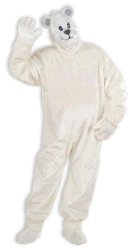
Now there's this little incident. For those who don't follow things like this, there was a segment in one episode of the recent documentary series Frozen Planet in which a scene of a polar bear in the wild cut to a scene showing some cubs being born, before cutting to a scene of some cubs leaving the nest for the first time. The BBC was very clear on their website that the scene of the cubs being born was filmed in a zoo, and gave good reasons for doing so - it would be impossible to get such a shot in the wild because the polar bears don't build their dens, they simply lay in a snowstorm and let nature do the work for them. Any attempt to put a camera in the den after it's formed will prompt the polar bear to eat either the cubs or the cameraman. So basically the BBC made the decision, rather than to omit a large chunk of video, to show a short scene of some cubs being born in captivity. Many of the non-BBC media evidently consider this cheating.
It's worth noting that these things happen all the time in nature documentaries. Just looking at Frozen Planet, there are scenes early on in the series that show ice melting, filmed as time lapses. You could argue that this is 'fake' because it's not showing the ice melting at the speed it really does. But ask yourself - would you really want to watch hours of video of ice melting? No, didn't think so. The point is that it doesn't matter if the shots are edited, it's damn good telly.
It's also worth mentioning David Attenborough's previous series, Life. There was a whole episode about plants and the best shot of the entire series, in my opinion, was completely 'faked'. There's a wonderful 30-second scene of a woodland 'coming to life' as plants grow in speeded-up motion. Obviously they couldn't do a time lapse in a genuine wild wood, so they painstakingly recreated the wood in a studio and filmed the scene twice - once in real time on location and then again over the course of an entire year in a studio against a green screen. They then later blended the two shots together to get the finished scene. In the behind-the-scenes footage it shows how they had to ensure that the path of the camera was identical in both instances, how they had to time the plants to grow at just the right times while the camera was on them, and how they had to make sure that the studio scene was identical to the location shot to the centimetre. The shot lasted 30 seconds and took two entire years to plan, set up and film. The end result was a completely 'fake' scene which looked absolutely beautiful and was far harder to produce than any genuine footage could ever be. Is this also 'cheating'? Or would you prefer to see just a 30-second real-time shot of a wood sitting there and doing not very much?
The fact is that TV isn't supposed to be real, it's supposed to entertain. And, my views on polar bears being kept in captivity aside, I personally was very entertained by seeing a little baby polar bear cub in a den with its mother. The experience would have been lessened if the shot had been missed out, or if they'd flashed up a warning on screen to say "by the way, this shot is filmed in a zoo".
So why is this series getting so much stick in the first place, I wonder? Could it be something to do with the fact that the final episode of the series is the first bullshit-free documentary on the effects of climate change that I've ever seen, and that certain people want to discredit it? Hmm.